
How students are helping Google to rethink city services
Jonathan Andrews, North American Editor at the City Innovation Network, reports on a new initiative by the global tech company to drive civic innovation through student collaboration
What if reporting a pothole to city hall were as simple as scrolling through TikTok?
That was one of the ideas to emerge when Google challenged university students in Georgia to rethink how residents interact with local government. The result was GovTalk, a working prototype that borrowed the familiar swipe-based interface of social media to help people report neighbourhood problems.
For the City of Mableton, a relatively new municipality outside Atlanta, the experiment offered a fresh approach to improving its 311 services despite limited staff and budgets. It also demonstrated how university students, equipped with AI tools and technical mentoring, could become a resource for local government innovation.
For Erin Relford, Senior Privacy Engineer at Google, who helped develop the challenge, the quality of the student prototypes came as a surprise.
“Seeing the entire working prototype I said, ‘Wow, these people, these students are going to put me out of a job!’”
Connecting students with city challenges
The idea emerged after Relford attended a United Nations technology event featuring a hackathon. Working alongside Google’s public policy team, which engages with municipalities, she began considering whether the company’s developer infrastructure could address practical local government problems.

Erin Relford, Senior Privacy Engineer at Google
“I thought to myself, why are we not doing this? Because we have the infrastructure and the footprint,” she tells the City Innovation Network.
That infrastructure includes Google Developer Groups (GDGs), which Relford says comprise more than 2,300 chapters across 145 countries. Combined with Google’s educational programmes, the network provides a way to connect emerging talent with municipal needs.
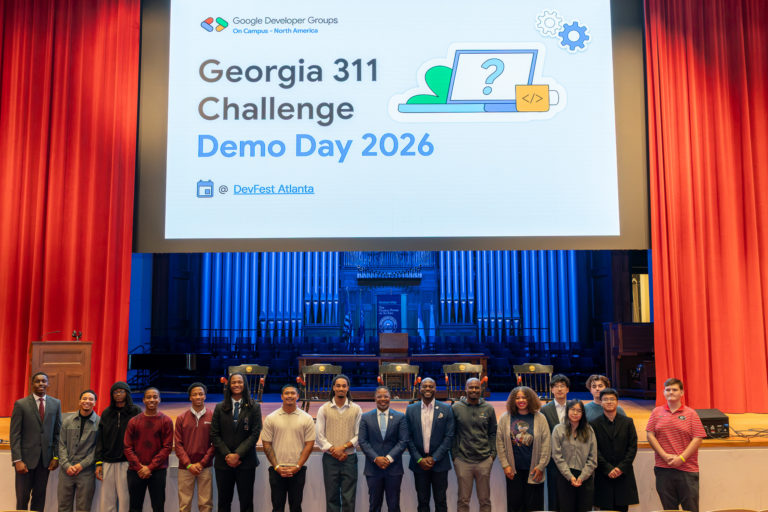
Mableton provided a suitable starting point. The mayor, Michael Owens (pictured centre), had outlined his ambition to build a paperless, digital-first city, while limited resources created challenges in responding to residents’ enquiries and making government information accessible.
The city’s 311 services became the focus of the pilot, giving participants a defined problem to solve. The challenge formed part of Google DevFest Atlanta, held at Morehouse College in late October, bringing together students and developers from institutions including the college, Georgia Institute of Technology, the University of Georgia and Kennesaw State University.
Google established a framework to ensure students’ ideas addressed municipal needs and incorporated appropriate safeguards. Participants were recruited through GDG chapters and received a problem statement, technical mentoring from developer advocates and access to educational resources including Career Launchpad, Google Career Certificates and Google Skills credits.
Privacy and data governance were built into the exercise from the beginning, with Relford establishing the rules governing how students could work with municipal information.
“I’m a senior privacy engineer. So, fortunately, they had me on board to basically design this challenge to say that we would only use public data,” she explains.
The challenge excluded personally identifiable information from working prototypes, while Google specified acceptable tools and resources. Students also needed to understand which municipal systems and application programming interfaces (APIs) were available to support their ideas.
One unexpected obstacle, however, was not technical. Some students questioned whether they possessed sufficient expertise to participate, despite bringing knowledge from disciplines beyond computer science.
“One thing that we had to deal with was them feeling like they don’t have the [confidence], to participate. Am I good enough to actually do this?” Relford recalls. “I think with AI, what a lot of people don’t realise is that it gives you the access and the agency to do things that you wouldn’t normally be able to.”
The challenge became an exercise in building confidence as much as developing technology. Relford points to Owens’ observation that students from disciplines such as sociology and urban planning already possessed valuable knowledge, with AI helping them translate ideas into working software.
Fresh thinking on civic engagement
The demonstration day was Relford’s first opportunity to see the completed prototypes. Although she had been available to answer questions during development, their creativity exceeded her expectations.
GovTalk illustrated how students approached municipal problems from a different perspective. Rather than designing another conventional government service portal, they drew on the digital experiences shaping how younger generations interact with technology.
The prototype, which mimics the swiping style of social media, offers a potential alternative to conventional reporting channels, although it has yet to be deployed as a public service. It also demonstrates how familiar consumer technology experiences might be adapted to encourage civic participation.
Students gained experience addressing genuine municipal problems, while city officials could observe emerging technologies being applied to their operational challenges.
Relford believes this exchange helps public servants become more comfortable experimenting with unfamiliar technologies.
“I would really want people to notice that there’s an education by ‘doing’ for everyone involved. They’re learning to use these resources, so they get to see these students do it first. And it’s kind of like double Dutch [a skipping game involving two ropes turning in opposite directions], where you’re a little nervous to jump in,” she explains.
From prototypes to practical use
The next stage rests with Mableton, where the mayor and his team plan to assess the prototypes and explore whether any could be developed for public use. Google is not participating in the city’s subsequent evaluation or potential implementation process.
The prototypes remain at an early stage, and their impact will depend on whether the city chooses to develop and deploy them.
For Google, the pilot has demonstrated the potential to connect local government, university students and the wider community. Relford says the company can also monitor participation in its educational programmes to assess workforce development benefits.
Longer-term evaluation could examine whether prototypes become operational services and produce measurable benefits. Relford explains that the company is exploring similar challenges with three other cities, which have yet to be named.
She sees opportunities to broaden participation in future challenges, particularly by involving non-profit organisations and small businesses alongside students and city officials. She is also interested in introducing technologies that could help municipalities survey residents and gather community feedback.
“I wouldn’t adjust a thing when it comes to the actual challenge because I was quite surprised with the results that we were given,” she adds.
For other cities, Mableton’s experience highlights the importance of identifying a genuine municipal problem, securing leadership involvement and establishing data safeguards before development begins. Access to mentoring and developer networks can also help smaller municipalities experiment without extensive in-house expertise.
The longer-term test is whether promising prototypes can become reliable public services. That requires further evaluation, technical development and decisions about ownership and support, particularly where municipal resources are limited.
For Relford, the experience raises a broader question about how cities can make better use of young people’s skills and perspectives. Beyond the immediate challenge, she sees an opportunity to bring emerging talent into public service innovation.
“I don’t think we have quite tapped into the resources of talent that are coming up in this next generation,” she says.