Tag Archive for: AI

OpenAI and Rockefeller launch US$50 million cities AI fund

The OpenAI Foundation and The Rockefeller Foundation have launched a US$50 million funding programme to help city governments improve public services using artificial intelligence (AI), with grants of up to US$2 million available to organisations working alongside municipalities worldwide.

The Cities Deliver initiative aims to reach up to 100 million residents, supporting projects focused on public health, economic mobility, environmental resilience and civic engagement.

Anna Makanju (pictured), Head of AI for Civil Society and Philanthropy at The OpenAI Foundation, told Cities Today that applicants will need to demonstrate practical benefits rather than simply experiment with emerging technology.

“The goal is to support projects where AI is core to solving a demonstrated problem, rather than projects experimenting with AI for its own sake,” she said. “We do want to see potential for scale–whether that is to more residents, new jurisdictions, or additional services.”

Funding and eligibility

Seed grants of US$500,000 to less than US$1 million will support prototype development and initial city pilots, while scale grants of US$1 million to US$2 million will help expand solutions that have already demonstrated results.

City governments cannot apply directly but must partner with an eligible organisation. Makanju said municipalities will not be required to provide matching funding or possess specialist AI expertise.

“The initiative is designed to recognise that cities have different levels of resourcing and technical capabilities,” she said. “Grants will go to eligible organisations working alongside them, and the programme is going to ensure that grantees are able to access peer learning, mentorship and potential technical support subject to capacity.”

The programme builds on Rockefeller-supported AI projects in Cali, Colombia, where technology forecasts dengue outbreaks; Cape Town, where a messaging platform supports resident engagement; and Rio de Janeiro, where AI assists flood response.

Makanju said these projects highlighted the importance of ensuring new technologies work alongside existing municipal systems, rather than requiring cities to overhaul their infrastructure.

Beyond the pilot

Successful applicants must establish plans to evaluate outcomes, protect residents’ data and integrate solutions into existing services. Grants will run for 24 months, with no guarantee of further funding.

“Sustainability is also part of the approach from the outset,” Makanju added. “Projects need a credible path to integration into existing city systems if successful, and a patch to securing the support needed to continue beyond the 24-month grant period.”

Applicants can choose their preferred AI models and products, with no requirement to use OpenAI technology. Applications are open until 29 November 2026 through the Cities Deliver application portal.

Image: OpenAI Foundation

Pittsburgh’s new CIO targets AI and digital modernisation

ittsburgh’s newly appointed CIO, Sylvia Harris, has outlined plans to modernise ageing technology, expand the use of artificial intelligence and improve digital services, while addressing longstanding infrastructure and cybersecurity challenges.

Harris, who has worked for the City of Pittsburgh for 18 years, has been appointed Director of Innovation & Performance and Chief Information Officer by Corey O’Connor, Mayor of Pittsburgh, after serving in an acting capacity.

“My first priority is strengthening the fundamentals–ensuring our systems are reliable, secure, and resilient,” Harris told Cities Today. “Residents expect government services to work every time, and that requires disciplined investment in infrastructure, cybersecurity, and operational excellence.”

Among the city’s biggest challenges are ageing IT systems, fragmented departmental processes and the need for consistent investment in modernisation.

Harris wants to upgrade legacy platforms, improve data quality and expand cloud-ready systems that allow departments to work together more effectively. A key ambition is to establish a unified digital gateway through which residents and businesses can access municipal services.

This would simplify everyday interactions, including applying for permits, reporting problems and accessing information, with an emphasis on intuitive, mobile-friendly services.

AI opportunities

Harris also sees opportunities for AI to reduce administrative workloads and improve service delivery, although the city is taking a measured approach to adoption.

“AI has real potential to improve how Pittsburgh operates, but we’re approaching it with intention and responsibility,” she said. “Our focus is on practical applications and use cases that help staff do their jobs more efficiently and improve the resident experience.”

Potential internal applications include document drafting, data analysis, customer service triage and automating repetitive tasks, freeing employees to concentrate on more complex work.

For residents, Pittsburgh is considering smarter 311 service request routing, more intuitive digital forms and real-time information. The city is also exploring AI for infrastructure monitoring, public safety analytics and operational forecasting.

Harris said any deployment must be secure, equitable and transparent, with privacy and public trust central to decisions about where the technology is used.

Cybersecurity foundations

Harris brings more than 30 years of IT and leadership experience to the position. Since joining Pittsburgh in 2008, she has held several senior technology roles, including Chief Information Security Officer and Deputy Director of Operations.

Her achievements include establishing the city’s cybersecurity programme, implementing a disaster recovery solution and creating an incident response and training team.

That background has shaped her approach to leadership, with security considerations influencing everything from vendor selection and system design to staff training.

“We’re strengthening our cyber hygiene, expanding training, and improving incident response capabilities,” she said. “But just as important, we’re building a culture where cybersecurity is everyone’s responsibility–from leadership to frontline staff.”

Alongside the technical changes, Harris is prioritising professional development and closer collaboration between departments, recognising that successful modernisation depends as much on employees as technology.

Her longer-term ambition is to bring Pittsburgh’s disparate systems and services together into a more coherent digital environment.

“In two to three years, I want Pittsburgh to have a unified digital ecosystem that is secure, modern, and easy for residents to navigate,” she said.

Image: City of Pittsburgh

How Berlin is using AI to simplify benefit applications

More than half a million people in Berlin receive some form of social benefit, including income, health or child-related support, yet an estimated 40 to 60 percent of eligible people across Germany never even apply.

“Applying for social benefits is actually a pretty big pain for residents but also for the caseworkers on the government side,” Ben Seibel, CEO, CityLAB Berlin tells Cities Today. “These forms are really long. The language is very bureaucratic, and the process is really slow.”

CityLAB Berlin, the Berlin Senate-funded public innovation laboratory, has taken it on itself to transform the application system because even when people overcome the initial barriers, their applications frequently require further work.

CityLAB says around 90 percent of initial applications for social benefits are incomplete or contain an error. Officials must then request missing documents or clarify answers, contributing to waiting times of between three and five months.

“This is for people in very difficult situations,” says Seibel. “They do not have much money, so waiting for months for social benefits is actually a huge problem.”

Digital forms are not necessarily the answer because moving the questions from paper to screen leaves the underlying challenges unchanged.  Residents are still expected to interpret official terminology, establish which type of benefit they can claim, and put together the correct information.

CityLAB Berlin and Google.org, Google’s philanthropic arm, have been exploring whether agentic AI could provide a different route through that process. The two-year Beyond Forms project is developing an AI assistant that can identify relevant support, guide residents through an application and complete the required form.

Testing before implementation

CityLAB investigates emerging technologies and develops prototypes before the government considers putting them into operational use.

“The mission of CityLAB is to do some kind of early exploration of new technological concepts that, at a later stage, might be integrated into government,” says Seibel. “Government IT is usually pretty slow and pretty expensive, and the idea of an innovation lab is to have a kind of speedboat charting the path for the future.”

For Beyond Forms, the team examined existing application processes with the Berlin Senate Department for Labour, Social Services, Gender Equality, Integration, Diversity and Anti-Discrimination. It interviewed benefit recipients and caseworkers to identify where applicants struggled and what created unnecessary work for staff.

One finding was that residents were already using generative AI services such as ChatGPT for help. CityLAB saw risks in sharing sensitive personal data with a commercial platform, so the alternative was to develop an open-source prototype capable of being hosted by cities themselves.

Building around the resident
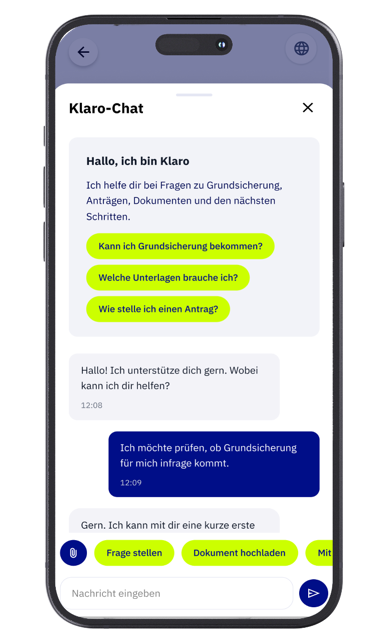
The prototype begins with an eligibility check so residents can establish whether they should apply for a particular benefit. A mobile-friendly conversational interface then gathers the information needed for the application.

Applicants can upload photographs of documents such as passports and rental contracts rather than copying every detail. AI-supported analysis extracts relevant information, while a guided questionnaire collects anything missing and a chatbot explains questions.

“It will ask you exactly those questions that are missing, and it will ask the questions in a way that is very easy to understand for users,” says Seibel. “You basically have a conversation, like: ‘Let’s have a look at your income. How much money are you making? Do you have a job? How much rent are you paying?’”

The AI uses the answers to populate the application, then presents the completed form to the resident for approval.

The team repeatedly tested early concepts with residents and caseworkers, while members of the public tried the prototype at CityLAB’s summer conference.

“We were constantly building and testing solutions to see what truly helps citizens, and then by powering this tool with AI, our core mission is to empower the users to fill out these forms faster and also with much greater accuracy,” says Nathalia Andrijic, Senior UX Researcher, Google.org Fellowship.

Starting with paper

CityLAB selected basic income support for older people as its first use case. Around 100,000 Berlin residents receive basic income support but the service chosen for the prototype had no digital application system. Applicants had to complete a paper form and send it by post.

Rather than viewing that as an obstacle, the team saw an opportunity to begin without connecting the prototype to a legacy platform.

“We thought this could be an easy way to leapfrog innovation because there was no digital system in place that we would have to connect with,” says Seibel. “Beyond Forms doesn’t care if there is a paper form. It will just fill out the form for you.”

The system can complete an existing PDF that the applicant then prints and submits, allowing it to help residents even when the public authority still depends on paper. CityLAB is adding other services so the assistant can help users identify appropriate support rather than assuming they already know which application they need.

Working with Google fellows

CityLAB secured support by applying to the Google.org Fellowship programme.

“Through a Google.org fellowship, we provided a dedicated team of Google employees to support this shared vision pro bono for six months, and we supported CityLab with a US$1 million grant to continue the project,” says Marco Lohse, Senior Programme Manager, Google.org.

The interdisciplinary team included employees from Berlin, London and Zurich. Seibel says the fellows acted as a technical “sparring partner” as CityLAB explored how an AI agent should interact with residents, including older applicants.

The teams worked in development sprints and produced a first prototype and early open-source release during the six-month fellowship. CityLAB is continuing the project independently until the end of 2027.

Keeping people in control

Beyond Forms remains a research project rather than a finished public service. CityLAB is evaluating different AI models and how accurately they can interpret information and provide guidance.

“We do not have the final solution for privacy and also for correctness,” Seibel says. “We’re evaluating different kinds of AI models, for example, and how precise they can be.”

The system follows a human-in-the-loop approach. It can collect information, answer questions and prepare an application, but nothing is submitted without the applicant’s approval. Responsibility for official decisions remains with the public authority.

Although Google.org supported its development, the software is vendor-agnostic. A city could operate its own version in its own computer centre instead of relying on Google or another external cloud provider. Administrations could also upload their existing forms and use AI to convert them into a machine-readable format.

The same components could eventually support services beyond social benefits, such as parking permits. Charities that help people claim benefits could also deploy the system without accessing internal government systems.

For CityLAB, the decisive result would be real-world adoption. The next stages will test whether Beyond Forms can help more eligible residents apply, reduce errors and ease the workload for caseworkers.

“We hope to get these error rates down a lot,” says Seibel. “If forms have fewer errors, it’s also less work for government caseworkers. We hope in the end it’s a win-win situation: easier for citizens but also easier for caseworkers.”


 

San José opens permanent gateway for civic tech ideas

San José has launched an IT Innovation Hub to give technology companies a permanent and structured way to present solutions for improving government operations.

The portal is designed to sit alongside, rather than replace, the city’s traditional procurement tools, providing a more transparent and accessible route for engagement.

“The IT Innovation Hub complements the RFI and RFP processes by offering a clear and transparent way for vendors to submit ideas at any time,” a spokesperson from the Information Technology Department told Cities Today. “City staff have long received technology pitches by email, those messages can often be missed due to high volume or email filters. The Innovation Hub ensures that proposals have a dedicated space to be reviewed regularly and shared with the appropriate departments.”

The year-round portal aims for San José to stay abreast of new technologies and trends while giving vendors confidence that their ideas will be reviewed fairly and consistently.

“By reviewing submissions monthly and inviting selected vendors to IT Vendor Days, the city can quickly identify promising ideas worth exploring,” said the spokesperson. “This streamlined approach makes it easier and faster to test new solutions, saving time and resources while keeping the city at the forefront of innovation.”

To ensure that innovation does not come at the expense of governance, the city has embedded policy and security compliance into the process.

“All submissions must comply with San José’s AI Policy, Data Governance Policy, and cybersecurity standards, which are listed on the Hub’s webpage,” the spokesperson added. “These are built into the evaluation process, so vendors understand requirements before they present.”

All new technologies undergo review by the City’s Privacy and AI, Cybersecurity, Business Solutions, and Infrastructure teams to confirm compliance with standards for data protection, responsible AI use, and transparency.

“The city evaluates pilots focusing on areas including how well the technology works, if it can be scalable and grow with city needs and infrastructure, and the value it can provide to the city including cost savings, service improvement, and overall government efficiency,” the spokesperson said. They pointed to the Road Safety Conditions Pilot, where AI tools were judged on accuracy and usefulness before advancing to a formal RFI process.

San José sees this model as one that other local governments could adopt.

“Make your process clear, consistent, and open to all,” they said. “[We] created the IT Innovation Hub as a structured way for vendors to submit ideas and be reviewed using the same process, evaluation criteria, and feedback timeline.”

The spokesperson added: “Above all, cities should be ready to listen, learn, and adapt. Good ideas can come from anywhere, and cities should create space to hear them while staying true to community values and public service goals.”

Image: Adrianadh | Dreamstime.com

Denver expands CIO role to include AI

Denver has become one of the first US cities to formally embed artificial intelligence into its top technology leadership, with Suma Nallapati’s role expanded from Chief Information Officer to Chief AI and Information Officer.

The new title reflects the city’s ambition to be seen as the nation’s most forward-thinking AI city and to ensure that technology is deployed in ways that are equitable, secure, and centred on residents.

“Implementing AI across city government inherently presents a few risks–bias and equity, transparency and accountability, and security and data protection,” Nallapati (pictured) told Cities Today. “My strategic approach aims to mitigate these risks by diving in with eyes wide open.”

Nallapati pointed to the city’s AI Request for Proposals as a major milestone. The initiative is designed to create a pool of trusted vendors capable of delivering secure, scalable, and innovative solutions tailored to Denver’s needs.

Following a strong response, the city is now reviewing submissions against criteria such as technical strength, compliance with security standards, scalability, cost, and innovation potential. Each vendor must also complete a detailed risk assessment, which is scrutinised by Denver’s security and privacy teams.

The city’s most visible deployment so far is Sunny, a multilingual chatbot supporting residents via web, text, and WhatsApp. Between January 2024 and September 2025, Sunny engaged with more than 102,000 residents, answered nearly 100,000 questions, achieved a 90 percent satisfaction score, and absorbed 30 percent of daily 311 interactions.

“I believe AI’s success is ultimately defined by how much better it makes life for our teams and the people we serve,” Nallapati said. “With tools like Sunny, we’re tracking the number of residents engaged, our customer satisfaction score, the percentage of daily interactions that are being absorbed by Sunny that would have historically been routed through our 311 call centre, and more. And, since Sunny can recognise 72 different languages, we’re also ensuring the service is accessible and equitable for every Denverite.”

Her wider strategy focuses on transparency and collaboration with an approach to AI that is grounded in active engagement and collaboration.

“We are not just planning transparency; we are practicing it,” she said. “Last year, we successfully launched workshops to boost AI literacy among our city agency, who also contribute their expertise to policy review through our Information Governance Committee.”

Nallapati said Denver is drawing on national best practice by working with universities and foundations, including participation in the Bloomberg City Data Alliance, which is helping shape ethical guidelines and resident data initiatives. At the same time, the city is expanding its existing feedback systems so that residents can directly raise questions about AI, making public input a formal part of how new tools are deployed.

Collaboration with vendors will continue but without ceding control.

“We absolutely need the expertise of partners, but Denver will maintain control and accountability,” Nallapati said.

The city will retain 100 percent ownership of its data and will audit the algorithms, and the city’s in-house team will ensure vendor systems meet standards for ethics, transparency, explainability, data protection, and security.

Nallapati added that Denver aims to set the national pace by embedding AI across every layer of government, from data governance and policy to frontline services.

“Our mission is to seamlessly weave AI into the resident experience,” she said. “Our ultimate goal is to become the blueprint for AI-enabled cities where technology actively enhances equity and access.”

Other US cities and states that have already added, or plan to add, significant AI roles to their workforce include Louisville, New York State, Montana and New Jersey.

Image: City and County of Denver