Tag Archive for: artificial intelligence

Liverpool explores shared AI computing for public services

The Liverpool City Region is assessing whether shared computing infrastructure could help its six local authorities, researchers and businesses use AI securely, working with software company K2K and NVIDIA.

The UK Combined Authority said the work would examine whether shared access could reduce duplication, strengthen local control and retain more of the economic value generated by AI within the region. An initial phase is expected to begin in late October.

“Collaborating with NVIDIA will help us understand how accelerated computing and AI applications could support a secure regional AI computing centre,” said Tiffany St James, Chief AI Officer at Liverpool City Region Combined Authority.

“Our task is to connect that technical expertise to the needs of Liverpool City Region and establish whether a shared approach can improve services, support innovation and create opportunities for local people.”

The assessment will bring together the six authorities, universities, public service partners and industry to examine demand, data security, skills requirements, energy use and affordable funding and delivery options.

It will explore how K2K’s technology could turn operational information into real-time insights for traffic management and recycling. Its vision language models, built using NVIDIA technology, help interpret visual information to support decisions.

The initial phase will recommend whether the Combined Authority should proceed. Any subsequent investment would be subject to public procurement and formal approval.

Sharing infrastructure

Liverpool’s assessment is among several European projects involving NVIDIA technology for city operations and public services, including building management, resident enquiries and urban planning.

Esther Lee, Head of Product Marketing for NVIDIA Metropolis

Esther Lee, Head of Product Marketing for NVIDIA Metropolis, told Cities Today: “Depending on the application, deployment can start with a single server and expand as needs grow. We’re seeing cities pool demand across departments and with universities and research centres, including in Liverpool.”

Lee said Liverpool is testing applications, while Belfast is exploring a pilot. The regional computing proposal is at the assessment stage, with findings to be considered before any commitment to a later phase.

European deployments

Lee added that Côte-d’Or and Cinisello Balsamo have progressed beyond pilots, although scope varies by project.

In France, Côte-d’Or is working with Akila and ThinkDeep on agents supporting energy management, compliance, safety and climate resilience across more than 500 public buildings. The system combines sensor, infrastructure and historical data in a digital twin.

The company reports a 10 percent reduction in total operating costs and document searches shortened from weeks to minutes.

In Italy, Cinisello Balsamo is introducing locally operated computing infrastructure supporting translation, citizen chatbots and assistance with procurement and funding, with expansion to four additional municipalities planned.

In Liverpool, the assessment will establish whether shared infrastructure can support similar applications and deliver sufficient public value to justify investment.

St James from Liverpool added: “We are putting governance and public value at the start of the process. Evidence will guide each decision, and any future proposal will need to be secure, affordable and accountable to the region.”

Main image: Tupungato | Dreamstime.com

How a Californian city is raising productivity through a citizen hotline

When a resident contacted Suisun City in California with an unusual question about salvage rights to a sunken vessel in the harbour, finding an answer would normally have involved an exhaustive search of municipal records alongside a time-consuming consultation with a range of colleagues. Instead, Susie, the city’s AI-powered telephone and web assistant, found the information in minutes.

For a city (Town Hall pictured) with around 100 employees serving 30,000 residents, the incident illustrated how AI could help staff handle unexpected enquiries. The technology has since been deployed on a much larger volume of routine work.

“Usually whenever you get a question like that, you don’t really know where to even start to look, and it’ll probably take a longer time to do so,” Kim Bui, Demand Generation Specialist at Polimorphic, the company behind the assistant, tells Cities Today.

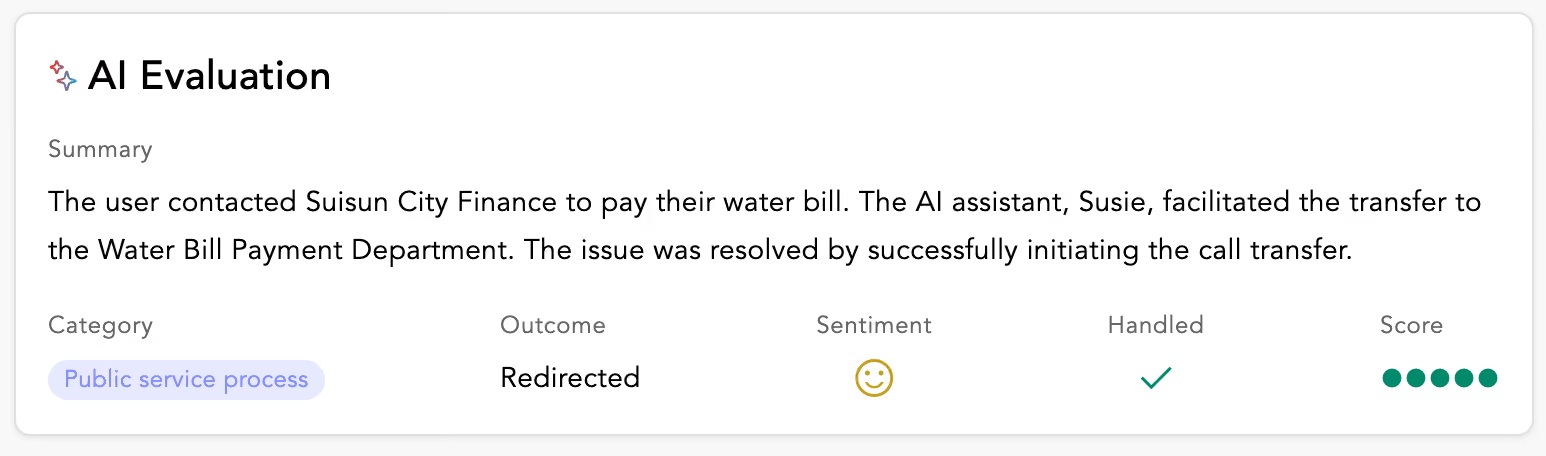
Suisun City has extended the deployment into its finance department, where employees previously spent considerable time redirecting residents to an external utility-billing provider. The deployment has also given the city information about the questions residents ask and where its communications need improving.

Starting with a familiar problem

Suisun City’s challenge was the time employees spent helping residents find information. Questions about bills and municipal services repeatedly reached a small workforce managing competing responsibilities.

The city introduced its main AI telephone line in September 2025. Susie draws on information published by the municipality, allowing residents to obtain answers without waiting for an employee.

According to Bui, the initial deployment took approximately an hour to configure, without requiring extensive changes to existing systems.

Early results attracted interest from the finance department, which was receiving large numbers of utility-billing calls. Payments were handled by a third-party provider, leaving employees frequently explaining procedures and transferring callers.

Kim Bui, Demand Generation Specialist at Polimorphic

“They told us these pain points of ‘we take so many calls, but once we get them, it’s just a switch, a transfer at the end of it’,” Bui says.

Polimorphic worked with finance employees to understand the enquiries they received and how calls were handled. A dedicated hotline followed in December 2025.

Getting the groundwork right

The initial deployment relied on information already available to the public rather than requiring the city to prepare extensive internal datasets.

Susie uses material from the city’s website and police website. It does not access internal databases or individual utility accounts, limiting the technical work required before launch.

“Setup usually doesn’t take that long, especially for our chatbot, because it’s already operating on the content that you already have,” Bui says.

The assistant is not currently connected to the city’s utility-billing software, supplied by Tyler Technologies. It therefore provides general billing guidance and directs residents to the billing provider rather than accessing individual account details. Bui says integration is planned but is not currently a priority.

Suisun City also had no formal AI policy before deployment and has not introduced one since. Instead, the company says security and privacy are addressed through safeguards built into the platform, restrictions on the information the assistant can access and analytics that allow interactions to be reviewed.

This approach has supported a relatively straightforward initial deployment, although applications involving individual records or transactions would introduce additional data access and governance considerations.

Measuring what changed

The finance department receives approximately 1,500 calls each month, with the assistant resolving around 70 percent without staff intervention.

Polimorphic counts a call as resolved when the resident receives the necessary information or direction without being transferred to an employee. This can include directing someone to the appropriate billing provider rather than completing a payment.

“If it doesn’t end in a transfer to a live person, then that’s how we know that the AI was successful at doing that,” Bui explains.

Initial figures suggested the service was saving approximately 40 staff hours a month, with an estimated annual value of US$25,000 in recovered staff capacity.

Updated figures supplied by Bui showed that the finance line had handled 11,659 calls since launch, saving an estimated 415.3 staff hours, equivalent to more than 50 eight-hour working days.

These figures represent estimated staff time saved, rather than confirmed reductions in expenditure. They also measure calls handled without staff intervention, not necessarily the completion of the underlying transaction.
Beyond the numbers

For employees, the reduction in telephone interruptions has implications beyond the estimated hours saved. Repeatedly stopping work to answer familiar questions can make it difficult to concentrate on other responsibilities.

The system records interactions and provides analytics showing what residents are asking, how calls are handled and whether enquiries are resolved.

Polimorphic’s customer success team reviews call logs each month with Michael Elm from the City Manager’s Office, identifying opportunities to improve responses and the information available to residents.

These reviews have highlighted gaps in the city’s published information. Repeated enquiries about a particular service can indicate that a webpage is incomplete or unclear.

“’Oh, okay, we need to update this page on the site because it doesn’t have the relevant information’,” Bui says, illustrating how staff can use the analytics.

The findings can inform updates to the website, potentially reducing confusion and the need for residents to contact the city in the first place.

Monthly reviews also allow Polimorphic and city employees to examine the assistant’s performance and identify recurring problems. The arrangement provides a continuing feedback process rather than treating deployment as a one-off exercise.

Building on the first deployment

Suisun City is considering extending AI into administrative workflows, including applications that currently require manual processing. The proposed next phase would move beyond answering questions to helping residents obtain responses more quickly.

Introducing workflows would require a different level of technical preparation. Unlike the existing telephone service, processing applications could involve accessing internal records, connecting to municipal systems and establishing controls over how information is handled.

For now, the main outcomes are the volume of enquiries handled without employee involvement, the estimated staff time recovered and the information collected about residents’ needs.

The next stage will test whether that approach can be extended to more complicated processes.

“The voice line was our proving ground, and it was incredibly successful. It showed the city that this is a viable solution for an understaffed, under-resourced city,” says Michael Elm from Suisun City’s City Manager’s Office. “We’re not using AI to replace jobs. We’re using it to supplement our team and bring residents a level of service we couldn’t provide before. The next phase is workflows, which will help residents get responses on applications faster and cut down processing time for staff.”

Main image: Kiddo27 / Wikimedia Commons / CC BY-SA 4.0

OpenAI and Rockefeller launch US$50 million cities AI fund

The OpenAI Foundation and The Rockefeller Foundation have launched a US$50 million funding programme to help city governments improve public services using artificial intelligence (AI), with grants of up to US$2 million available to organisations working alongside municipalities worldwide.

The Cities Deliver initiative aims to reach up to 100 million residents, supporting projects focused on public health, economic mobility, environmental resilience and civic engagement.

Anna Makanju (pictured), Head of AI for Civil Society and Philanthropy at The OpenAI Foundation, told Cities Today that applicants will need to demonstrate practical benefits rather than simply experiment with emerging technology.

“The goal is to support projects where AI is core to solving a demonstrated problem, rather than projects experimenting with AI for its own sake,” she said. “We do want to see potential for scale–whether that is to more residents, new jurisdictions, or additional services.”

Funding and eligibility

Seed grants of US$500,000 to less than US$1 million will support prototype development and initial city pilots, while scale grants of US$1 million to US$2 million will help expand solutions that have already demonstrated results.

City governments cannot apply directly but must partner with an eligible organisation. Makanju said municipalities will not be required to provide matching funding or possess specialist AI expertise.

“The initiative is designed to recognise that cities have different levels of resourcing and technical capabilities,” she said. “Grants will go to eligible organisations working alongside them, and the programme is going to ensure that grantees are able to access peer learning, mentorship and potential technical support subject to capacity.”

The programme builds on Rockefeller-supported AI projects in Cali, Colombia, where technology forecasts dengue outbreaks; Cape Town, where a messaging platform supports resident engagement; and Rio de Janeiro, where AI assists flood response.

Makanju said these projects highlighted the importance of ensuring new technologies work alongside existing municipal systems, rather than requiring cities to overhaul their infrastructure.

Beyond the pilot

Successful applicants must establish plans to evaluate outcomes, protect residents’ data and integrate solutions into existing services. Grants will run for 24 months, with no guarantee of further funding.

“Sustainability is also part of the approach from the outset,” Makanju added. “Projects need a credible path to integration into existing city systems if successful, and a patch to securing the support needed to continue beyond the 24-month grant period.”

Applicants can choose their preferred AI models and products, with no requirement to use OpenAI technology. Applications are open until 29 November 2026 through the Cities Deliver application portal.

Image: OpenAI Foundation

Pittsburgh’s new CIO targets AI and digital modernisation

ittsburgh’s newly appointed CIO, Sylvia Harris, has outlined plans to modernise ageing technology, expand the use of artificial intelligence and improve digital services, while addressing longstanding infrastructure and cybersecurity challenges.

Harris, who has worked for the City of Pittsburgh for 18 years, has been appointed Director of Innovation & Performance and Chief Information Officer by Corey O’Connor, Mayor of Pittsburgh, after serving in an acting capacity.

“My first priority is strengthening the fundamentals–ensuring our systems are reliable, secure, and resilient,” Harris told Cities Today. “Residents expect government services to work every time, and that requires disciplined investment in infrastructure, cybersecurity, and operational excellence.”

Among the city’s biggest challenges are ageing IT systems, fragmented departmental processes and the need for consistent investment in modernisation.

Harris wants to upgrade legacy platforms, improve data quality and expand cloud-ready systems that allow departments to work together more effectively. A key ambition is to establish a unified digital gateway through which residents and businesses can access municipal services.

This would simplify everyday interactions, including applying for permits, reporting problems and accessing information, with an emphasis on intuitive, mobile-friendly services.

AI opportunities

Harris also sees opportunities for AI to reduce administrative workloads and improve service delivery, although the city is taking a measured approach to adoption.

“AI has real potential to improve how Pittsburgh operates, but we’re approaching it with intention and responsibility,” she said. “Our focus is on practical applications and use cases that help staff do their jobs more efficiently and improve the resident experience.”

Potential internal applications include document drafting, data analysis, customer service triage and automating repetitive tasks, freeing employees to concentrate on more complex work.

For residents, Pittsburgh is considering smarter 311 service request routing, more intuitive digital forms and real-time information. The city is also exploring AI for infrastructure monitoring, public safety analytics and operational forecasting.

Harris said any deployment must be secure, equitable and transparent, with privacy and public trust central to decisions about where the technology is used.

Cybersecurity foundations

Harris brings more than 30 years of IT and leadership experience to the position. Since joining Pittsburgh in 2008, she has held several senior technology roles, including Chief Information Security Officer and Deputy Director of Operations.

Her achievements include establishing the city’s cybersecurity programme, implementing a disaster recovery solution and creating an incident response and training team.

That background has shaped her approach to leadership, with security considerations influencing everything from vendor selection and system design to staff training.

“We’re strengthening our cyber hygiene, expanding training, and improving incident response capabilities,” she said. “But just as important, we’re building a culture where cybersecurity is everyone’s responsibility–from leadership to frontline staff.”

Alongside the technical changes, Harris is prioritising professional development and closer collaboration between departments, recognising that successful modernisation depends as much on employees as technology.

Her longer-term ambition is to bring Pittsburgh’s disparate systems and services together into a more coherent digital environment.

“In two to three years, I want Pittsburgh to have a unified digital ecosystem that is secure, modern, and easy for residents to navigate,” she said.

Image: City of Pittsburgh

Shin-pei Tsay named Boston CIO

Shin-pei Tsay has been appointed Chief Information Officer (CIO) for the City of Boston, taking responsibility for the digital infrastructure and services supporting residents, businesses and the municipal workforce.

Tsay succeeds Santi Garces, who served as CIO for four years and has joined Harvard University to work on research and teaching related to government, artificial intelligence and innovation.

The appointment marks another expansion of Tsay’s responsibilities since she joined Boston in 2024 to lead the Mayor’s Office of New Urban Mechanics. She subsequently became Chief Research and Data Officer, launching Boston’s first citywide data strategy while overseeing research, analytics and the development of data products.

“Our team is driven by innovative leaders who bring creative solutions to improving city services and better serve our community,” said Michelle Wu, Mayor of Boston. “Shin‑pei Tsay will lead the Department of Innovation and Technology’s work to strengthen the digital tools and infrastructure that residents rely on, building on the strong foundation laid by Santi Garces.”

The department’s recent work has included overhauling municipal websites, making it easier to access property information and pay taxes online, and expanding Wicked Free Wi-Fi across schools, libraries, police and fire stations and other public buildings. The network serves more than 130,000 residents.

Boston has also adopted a citywide generative AI policy and worked with Google on the second phase of Project Green Light, which uses AI and traffic data to support the optimisation of traffic signals.

Tsay said technology now underpins almost every aspect of local government, from taking children to school and accessing property records to reporting problems in the street.

“Great technology infrastructure can immensely improve and scale public service so that it centres people,” she said. “I’m excited to continue building on all the resident-centred innovation Boston has done so that we can meet future challenges and expand access so that everyone can thrive.”

The new role brings Tsay’s previous work on research, data and experimentation under the broader remit of the city’s technology department. She told Cities Today last year that combining these capabilities could help Boston turn successful trials into citywide services.

“Launching a prototype isn’t the end goal; we want to see the prototype evolve and serve more residents,” she said. “To achieve this, we need data, research, performance management, and evaluation skills that can translate early ideas into scalable citywide policies.”

Tsay also recently told Cities Today that Boston was testing generative AI products designed to make its open data portal accessible without specialist analytical or programming skills. One tool uses Model Context Protocol to allow employees and residents to ask questions in natural language and search across multiple datasets.

Tsay has previously held senior roles at Uber, the Gehl Institute, TransitCenter and the Carnegie Endowment for International Peace.


San Diego lays the groundwork for AI at scale

San Diego is combining centralised governance, workforce training and practical deployments as it expands the use of artificial intelligence across its 13,000-strong workforce.

The city completed its AI policy and governance framework in 2024, bringing together the Department of IT, Human Resources, Office of Race and Equity, City Attorney, City Clerk, public safety, communications and performance and analytics teams.

All city employees then completed mandatory training on the policy before San Diego began deploying tools including Microsoft Copilot 365, Google Gemini and Copilot Chat in 2025.

Jonathan Behnke, CIO, City of San Diego, said rapid adoption and growing demand for more sophisticated applications led the city to establish a cross-functional AI centre of excellence.

Jonathan Behnke, CIO, City of San Diego

“We wanted to support that large volume of AI requests and minimise the risk of rogue AI across our city departments,” he told Cities Today.

The centre manages the city’s overall AI strategy, governance, standards, data enrichment, risk management, security, infrastructure, change management and financial oversight. Contracts with managed service providers have also been amended to align their work with the new structure.

An AI launchpad on the city’s intranet gives employees one place to access policies, governance information, approved solutions and training. It also includes an intake process through which departments can propose applications.

An AI governance subcommittee reviews those proposals, with 33 use cases submitted so far. The process gives the city a central route for reviewing departmental proposals while reducing the risk of uncoordinated AI use.

San Diego’s initial deployment of Microsoft Copilot 365 also underlined the importance of investing heavily in communication and training. Employees can access weekly live sessions, lunch-and-learns, office hours and guidance tailored to particular departments and functions.

“What we thought was maybe going over the top was exactly what the employees needed,” Behnke said. “Some people learn better with videos, some with hands-on workshops, some with live training and some with cheat sheets. We wanted to make sure we were providing all of those channels because everybody learns differently.”

A survey following the deployment estimated annual savings of 47,500 employee hours, equivalent to US$3.8 million in value. Most respondents said the technology improved the accuracy of their work, while most said withdrawing it would cause significant disruption after it had become part of their daily operations.

The city is now working with Google on an AI-supported procurement workflow being developed in response to California’s AB 339. Behnke said the law, which took effect on 1 January, requires government agencies to give labour organisations 45 days’ notice before certain procurements involving work performed by represented employees.

With Human Resources anticipating more than 12,000 submissions this year, the workflow is designed to help departments prepare statements of work, check submissions for compliance and allow corrections before human review. A conversational AI agent will be able to analyse submissions and identify potentially affected job classifications. The system will then support the final notification and start the 45-day review period.

Behnke sees scope to adapt the model to other processes involving submissions, departmental reviews and statutory deadlines.

The city will share its experience when it hosts the City Innovation Network (CIN) Leadership Forum North America on 9-10 September. The San Diego event will be the 61st city leadership meeting convened by the Cities Today Institute and the third regional meeting of CIN.

Behnke said discussions will cover internal efficiencies, public-facing applications, governance, executive sponsorship and securing budget support. One emerging concern is vendors’ shift from per-user licences towards consumption-based pricing, which makes future AI costs harder to forecast.

“I think it’s so beneficial for us to collaborate and exchange ideas, and learn from each other’s experiences,” he said. “I’m very excited about the September meeting.”


Main image: Sean Pavone | Dreamstime.com

Former Prague CIO joins Cities Today Institute

After five years leading innovation in Prague, Petr Suška is taking his experience to cities across Europe in his new role as Director of Innovation (EMEA) and Chair of the City Innovation Network in Europe at the Cities Today Institute (CTI).

Suška, who has also held roles with UNDP, Fraunhofer and Bosch, said the new position provides an opportunity to take the lessons learned in Prague and apply them across Europe by helping city leaders adopt practical approaches to innovation, data and artificial intelligence.

He was drawn to the role because of the Institute’s ability to bring together senior city leaders willing to openly discuss shared challenges and exchange practical experiences.

“As a CIO of the City of Prague, you get invited to a bunch of different things, and you tend to say no to those,” he told Cities Today. “However, the CTI events were the thing for me to always go to.”

For Suška, the value of the CTI events came not only from the programme itself but from the opportunity to learn directly from peers tackling similar issues, from AI adoption to digital transformation.

After five years leading innovation in Prague, he is now taking that experience to cities across Europe.

“I hope to do more practical things and help cities introduce real-world interventions to the way they operate,” he said, adding that his experience includes establishing open-source software sandboxes and agile AI development teams capable of introducing large language models across city government.

For Suška, the role is about moving beyond buzzwords. European cities, he argues, do not need more technology for technology’s sake. They need practical interventions that solve real problems: climate change, housing, mobility, public service delivery and the growing pressure on city administrations to do more with less.

“People ask, ‘Are you using AI with this?’ and the answer should be, you use AI if it brings value,” he said. “If it doesn’t, then maybe there’s a very low-tech intervention that you can take, because at the end of the day you’re trying to make an impact.”

Drawing on his experience in Prague, Suška said successful innovation starts with understanding the needs of residents and “the end users” before considering technology. Cities should also ensure they collect the right data to demonstrate whether projects improve efficiency, accessibility and public services.

“We always asked, how is this going to be used? Who is going to be using it? Is it going to be easy for them to use this, and are we collecting the right type of data?” he said.

As Director of Innovation (EMEA), Suška said he hopes to strengthen the City Innovation Network in Europe by creating more opportunities for cities to learn from one another and build trusted relationships that accelerate innovation.

“I always thought that it wasn’t just a source of inspiration, but it was also a relationship-building experience,” he said. “Having that kind of network of other city practitioners that are passionate about helping cities become more sustainable and liveable is a very empowering thing.”

Seattle sets new benchmarks with responsible AI plan

Seattle has launched a new Responsible AI Plan and Community Innovation Hackathon Series designed to strengthen how the city governs artificial intelligence while embedding fairness, privacy, and community engagement at the centre of its approach.

The plan expands policy beyond generative tools to cover all AI solutions, establishes clear rules for prohibited and high-risk uses, and commits to hiring a dedicated AI lead who will oversee a new cross-departmental AI Governance Group.

Rob Lloyd, Seattle’s Chief Technology Officer, told Cities Today that the new approach is designed to move beyond pilots and ensure projects are aligned with the city’s most pressing priorities. He explained that proposals must now demonstrate sponsorship and value and will be closely monitored to ensure they deliver results.

Rob Lloyd, CTO, City of Seattle

“There will be initiatives where things do not produce, but the goal is to catch them early and to fail forward for future work, protecting security, privacy, and resources,” he said.

Balancing innovation with the workforce

Lloyd stressed that the city is not rushing into AI adoption without preparing employees.

“The City of Seattle began with training and upskilling before rolling out general access,” he said. “Our intent in that Fundamentals, Approaches, and Solutions structure is to support the people and change management parts of what AI is causing our employees and teams to see.”

The city is prioritising AI for tasks that often go unfinished or add strain to staff, with the goal of reducing workloads and supporting better decision-making. Employees and labour partners are helping identify areas where AI can provide the most value, from accelerating insights to addressing work that otherwise cannot be completed—all without displacing jobs.

Measuring success and engaging communities

Seattle also wants to ensure historically marginalised groups shape how AI is used. “Through participation, outreach, and engagement. It invests in positive impact in and for these communities,” he said. “And by watching the impact and adjusting based on what we see. Seattle is a national leader in our community engagement work, including through the leadership of our Department of Neighborhoods and our Innovation and Performance Office.”

The new AI Plan includes a Community Innovation Hackathon Series in partnership with AI House, bringing together students, community members, technologists, and city staff. Its first hackathon theme, “Youth Connector,” is focused on using AI tools to improve awareness and access to mental health and enrichment programmes for young people.

The city will track outcomes against key measures such as performance, reliability, adoption, scalability, return on investment, and alignment with business goals. Lloyd said these metrics, combined with stronger governance and training, will help ensure AI is deployed responsibly and with lasting impact.

Seattle was one of the first cities in the US to release a generative AI policy in April of 2023, which was then iterated and fully implemented that October. The original policy established governing principles for the city’s approach to AI including: innovation, accountability, reliability, fairness, privacy, explainability, and security.

Main image: Gregor Doerr | Dreamstime.com

Denver expands CIO role to include AI

Denver has become one of the first US cities to formally embed artificial intelligence into its top technology leadership, with Suma Nallapati’s role expanded from Chief Information Officer to Chief AI and Information Officer.

The new title reflects the city’s ambition to be seen as the nation’s most forward-thinking AI city and to ensure that technology is deployed in ways that are equitable, secure, and centred on residents.

“Implementing AI across city government inherently presents a few risks–bias and equity, transparency and accountability, and security and data protection,” Nallapati (pictured) told Cities Today. “My strategic approach aims to mitigate these risks by diving in with eyes wide open.”

Nallapati pointed to the city’s AI Request for Proposals as a major milestone. The initiative is designed to create a pool of trusted vendors capable of delivering secure, scalable, and innovative solutions tailored to Denver’s needs.

Following a strong response, the city is now reviewing submissions against criteria such as technical strength, compliance with security standards, scalability, cost, and innovation potential. Each vendor must also complete a detailed risk assessment, which is scrutinised by Denver’s security and privacy teams.

The city’s most visible deployment so far is Sunny, a multilingual chatbot supporting residents via web, text, and WhatsApp. Between January 2024 and September 2025, Sunny engaged with more than 102,000 residents, answered nearly 100,000 questions, achieved a 90 percent satisfaction score, and absorbed 30 percent of daily 311 interactions.

“I believe AI’s success is ultimately defined by how much better it makes life for our teams and the people we serve,” Nallapati said. “With tools like Sunny, we’re tracking the number of residents engaged, our customer satisfaction score, the percentage of daily interactions that are being absorbed by Sunny that would have historically been routed through our 311 call centre, and more. And, since Sunny can recognise 72 different languages, we’re also ensuring the service is accessible and equitable for every Denverite.”

Her wider strategy focuses on transparency and collaboration with an approach to AI that is grounded in active engagement and collaboration.

“We are not just planning transparency; we are practicing it,” she said. “Last year, we successfully launched workshops to boost AI literacy among our city agency, who also contribute their expertise to policy review through our Information Governance Committee.”

Nallapati said Denver is drawing on national best practice by working with universities and foundations, including participation in the Bloomberg City Data Alliance, which is helping shape ethical guidelines and resident data initiatives. At the same time, the city is expanding its existing feedback systems so that residents can directly raise questions about AI, making public input a formal part of how new tools are deployed.

Collaboration with vendors will continue but without ceding control.

“We absolutely need the expertise of partners, but Denver will maintain control and accountability,” Nallapati said.

The city will retain 100 percent ownership of its data and will audit the algorithms, and the city’s in-house team will ensure vendor systems meet standards for ethics, transparency, explainability, data protection, and security.

Nallapati added that Denver aims to set the national pace by embedding AI across every layer of government, from data governance and policy to frontline services.

“Our mission is to seamlessly weave AI into the resident experience,” she said. “Our ultimate goal is to become the blueprint for AI-enabled cities where technology actively enhances equity and access.”

Other US cities and states that have already added, or plan to add, significant AI roles to their workforce include Louisville, New York State, Montana and New Jersey.

Image: City and County of Denver